Author: pluum

  • Custom Software Development Solutions: How Businesses Reduce Risk, Improve ROI, and Build Smarter Operations

    Custom Software Development

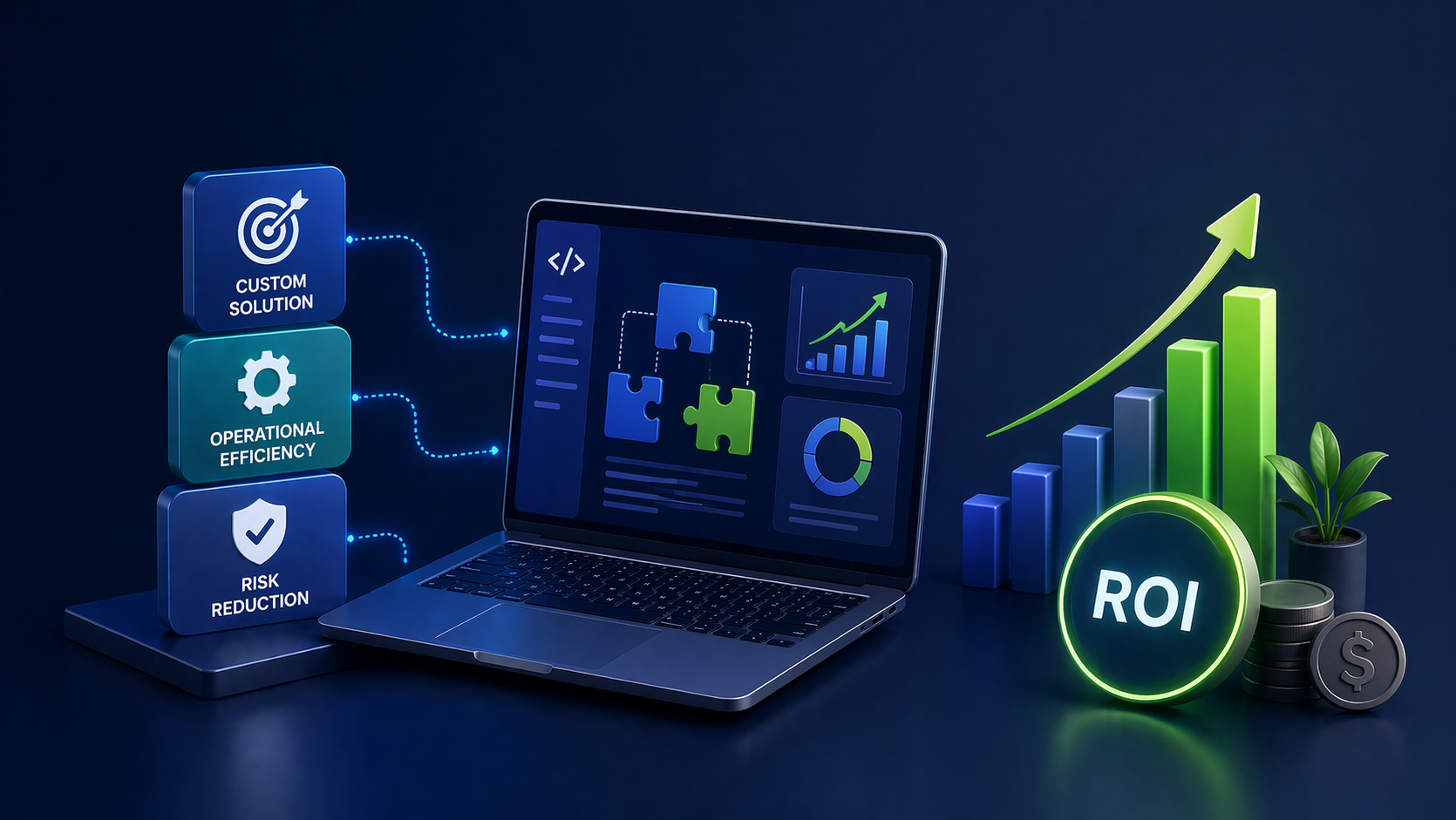
    Custom software development solutions are not just about building new digital tools. In 2026, businesses are looking at custom software as a way to reduce operational risk, improve return on investment, remove process waste, and build systems that support long-term growth.

    The custom software market continues to grow quickly. The Business Research Company reports that the custom software development market is expected to grow from $53.95 billion in 2025 to $65.85 billion in 2026, with a 22.1% CAGR, driven by demand for tailored software, limits of off-the-shelf applications, mobile and web adoption, and rising business-process complexity.

    Why companies are measuring software by business return

    A few years ago, many companies judged software projects by launch dates and feature lists. Today, that is not enough. A custom system must prove value through faster workflows, fewer manual tasks, better customer experience, lower risk, cleaner reporting, and stronger business control.

    The real question is not only, “Can this software be built?” The better question is, “What will this software improve every month?”

    For example, if a custom dashboard saves managers hours of reporting time, that is business value. If a client portal reduces repeated emails, that is business value. If automation prevents missed approvals, that is business value. If a secure system reduces data-handling risk, that is business value.

    This is where Enter and Post LLC can position custom software as a practical investment, not just a technical service.

    The hidden cost of disconnected systems

    Many businesses already pay for multiple software tools. They may use one system for CRM, one for accounting, one for payroll, one for documents, one for customer communication, and spreadsheets for reporting.

    The problem is not always the subscription cost. The bigger problem is the hidden cost of disconnected work.

    Employees may enter the same information multiple times. Customers may ask for updates that should already be visible. Managers may wait for reports that should be automatic. Finance teams may verify records manually. HR teams may track approvals outside the main system.

    These small issues create slow operations and increase the chance of errors. Over time, the business loses money through wasted hours, delayed service, missed opportunities, and poor visibility.

    Custom software development solutions help reduce this waste by connecting workflows into one practical system.

    Why ROI starts with workflow clarity

    A custom software project should not begin with technology. It should begin with workflow clarity.

    The company should understand where time is being wasted, where errors happen, where customers get delayed, where employees repeat tasks, and where managers lack visibility. Once those problems are clear, the software can be designed to reduce them.

    For example, a business may discover that employees spend too much time asking clients for missing documents. A custom system can solve this with a client portal, document checklist, automatic reminders, and status tracking.

    Another company may find that managers cannot see pending approvals. A dashboard can show approval status, overdue tasks, assigned users, and next steps.

    ROI improves when software solves specific problems instead of adding unnecessary features.

    Why custom software can reduce operational risk

    Risk is not only about cybersecurity. Operational risk also comes from messy processes, unclear responsibilities, missing records, manual approvals, and poor reporting.

    A custom system can reduce risk by creating structure. It can show who submitted a request, who approved it, when it changed, what document was uploaded, and what action is needed next.

    This is especially important for businesses that handle accounting, payroll, HR, healthcare, logistics, legal, customer service, or financial records.

    A custom solution can support:

    role-based access

    approval history

    document tracking

    user activity logs

    secure data handling

    backup planning

    automated notifications

    controlled reporting

    These features help the business operate with more accountability and fewer blind spots.

    Why outsourcing remains part of the ROI equation

    Many businesses do not have the internal team needed to build and maintain custom systems. That is why outsourcing remains a major part of software investment.

    Mordor Intelligence estimates the software development outsourcing market at $618.38 billion in 2026, growing from $564.22 billion in 2025, with projections of $977.04 billion by 2031. The report connects growth to demand for external digital-engineering expertise, generative AI adoption, and modernization pressure.

    This matters because companies are using external software partners to access skills faster. However, ROI depends heavily on choosing the right partner.

    A weak partner may create unclear documentation, poor testing, slow communication, and future maintenance problems. A strong partner helps define the business problem, plan the system, build carefully, test properly, and support the product after launch.

    Why AI-ready software needs structure first

    AI is influencing software decisions across industries. Businesses want AI to summarize documents, answer common questions, recommend actions, support customer service, detect missing information, and improve reporting.

    But AI cannot create strong results from weak systems. If business data is scattered across emails, spreadsheets, and disconnected apps, AI features may be unreliable.

    A custom solution can create the foundation for AI by organizing data, defining user roles, creating clean workflows, and connecting important records.

    TEKsystems’ 2026 digital transformation report says digital leaders are more likely to be satisfied with transformation progress than laggards, with 73% of digital leaders satisfied compared with 34% of laggards. The report also says digital leaders are 2.5 times more likely to embed digital transformation as a core pillar of business strategy.

    The lesson is clear: AI and automation work better when they are part of a larger business strategy, not random add-ons.

    Where custom software creates measurable value

    Custom software can create measurable value in several areas.

    Customer service improves when clients can check status, upload files, make requests, and receive updates without waiting for manual replies.

    Employee productivity improves when repetitive tasks are automated and information is easy to find.

    Management visibility improves when dashboards show real-time or near-real-time performance.

    Finance teams benefit when invoices, approvals, payments, and records are easier to track.

    HR teams benefit when onboarding, leave requests, documents, and approvals are organized.

    Operations teams benefit when tasks, deadlines, bottlenecks, and responsibilities are clear.

    This is why Enter and Post LLC can present custom software as a business improvement tool. The service is not only development. It is the creation of a system that helps the company work better.

    Why businesses should avoid feature overload

    Feature overload is one of the biggest threats to ROI. When a company tries to build everything in the first version, the project becomes more expensive, slower, and harder to use.

    A better approach is to start with the highest-value workflow. The first version should solve the most painful business problem clearly.

    For example, version one may include secure login, customer portal, document upload, status tracking, admin dashboard, reminders, and basic reporting.

    Later versions may include AI summaries, mobile apps, advanced analytics, deeper integrations, payment automation, and customer segmentation.

    This approach helps protect the budget and gives the business real user feedback before investing in advanced features.

    Why security affects ROI

    Security issues can damage trust, interrupt operations, and create financial loss. That is why secure design should be part of every serious custom software project.

    A custom system may handle customer data, employee records, financial information, business documents, payment details, or private communication. If the system is not designed properly, the business may face avoidable risk.

    Security planning may include secure authentication, encrypted communication, role-based access, audit logs, safe APIs, backup systems, and regular updates.

    Security is not just a technical requirement. It protects the business investment.

    Why maintenance must be planned early

    Software is not finished forever after launch. APIs change, browsers update, business needs evolve, users request improvements, and security risks shift.

    A software project without maintenance planning can become expensive later. Bugs may remain unresolved. Features may stop working. Integrations may break. Performance may slow down.

    Maintenance should be part of the original plan. Businesses should know who will support the system, how updates will be handled, how bugs will be reported, and how future improvements will be prioritized.

    This protects ROI because the system continues creating value after launch.

    What a strong custom software project should include

    A strong project should include discovery, planning, design, development, testing, launch, and support.

    Discovery identifies the real business problem. Planning defines version one and future phases. Design maps user flows, dashboards, data structure, permissions, and integrations. Development builds the system. Testing checks performance, security, usability, and workflow accuracy. Launch brings the software to users. Support keeps the system working and improving.

    This process helps the business avoid waste and reduce risk.

    A good project should also include clear documentation, source-code ownership, hosting access, user training, and post-launch support terms.

    Where Enter and Post LLC fits in

    Enter and Post LLC can help businesses build custom software around practical operational needs. Many companies do not need complicated technology filled with unnecessary features. They need systems that reduce manual work, improve visibility, organize data, support customers, and help teams work faster.

    A custom solution can support client portals, workflow automation, internal dashboards, accounting support, HR systems, reporting tools, document management, payment tracking, and AI-ready operations.

    The strongest positioning is simple: Enter and Post LLC helps businesses turn scattered work into structured, measurable digital systems.

    Conclusion

    Custom software development solutions can help businesses reduce risk, improve ROI, and modernize operations without forcing teams into generic tools that do not match their workflow.

    The best software projects start with business clarity. They identify where time is wasted, where errors happen, where customers are delayed, and where managers lack visibility. Then the system is designed to solve those problems in a practical way.

    As companies invest more in automation, AI-ready workflows, cloud systems, and digital transformation, custom software will continue to play a major role in business growth.

    If your business needs a client portal, internal dashboard, workflow automation system, reporting tool, accounting support platform, or AI-ready business solution, Enter and Post LLC can help plan and develop software built around real users, real workflows, and measurable value.

    CTA

    Ready to reduce manual work and improve business ROI with custom software? Contact Enter and Post LLC today to discuss your project and build a solution designed for real operations, real users, and long-term growth.
  • Custom Software Design in 2026: Why Security, Compliance, and Business Risk Now Shape Every Serious Project

    Custom Software Design

    Why software design is now a business risk decision

    Custom software design is no longer only about making an application look clean or function smoothly. In 2026, businesses in the USA and global markets need software that is secure, compliant, scalable, and built around real operational risk. A poor design decision can create more than a bad user experience. It can expose customer data, weaken financial controls, create compliance gaps, slow internal teams, and increase the cost of future development.

    The software world has changed because businesses now depend on connected systems. A customer portal may connect with payment tools, accounting platforms, CRM software, document storage, email automation, and AI features. That means design decisions now affect security, privacy, workflow speed, reporting quality, and business continuity.

    This is why companies should not treat design as a visual step only. The real value of software design comes from planning how users, data, processes, integrations, permissions, and future upgrades will work together. When that foundation is weak, even a beautiful application can become expensive to maintain and risky to operate.

    For companies like Enter and Post LLC, this creates a strong opportunity to position software design as a practical business protection service, not just a creative or technical service.

    The compliance reason businesses are rethinking software

    One of the biggest reasons software design has changed is regulation. Businesses now operate in an environment where privacy, cybersecurity, AI governance, and data handling rules are becoming stricter.

    The EU AI Act entered into force on August 1, 2024. Prohibited AI practices have been banned since February 2, 2025, and high-risk AI requirements become mandatory on August 2, 2026. Non-compliance can carry fines up to €35 million or 7% of global revenue, depending on the violation.

    Even if a company is based in the United States, global digital operations can still create exposure. A U.S. company selling services to customers in Europe, collecting user data from international clients, using AI-powered workflows, or offering software globally may need to consider privacy and AI-related obligations beyond its home market.

    This is where software design becomes strategic. Compliance is easier when it is built into the system early. It becomes more expensive when companies try to add it after launch.

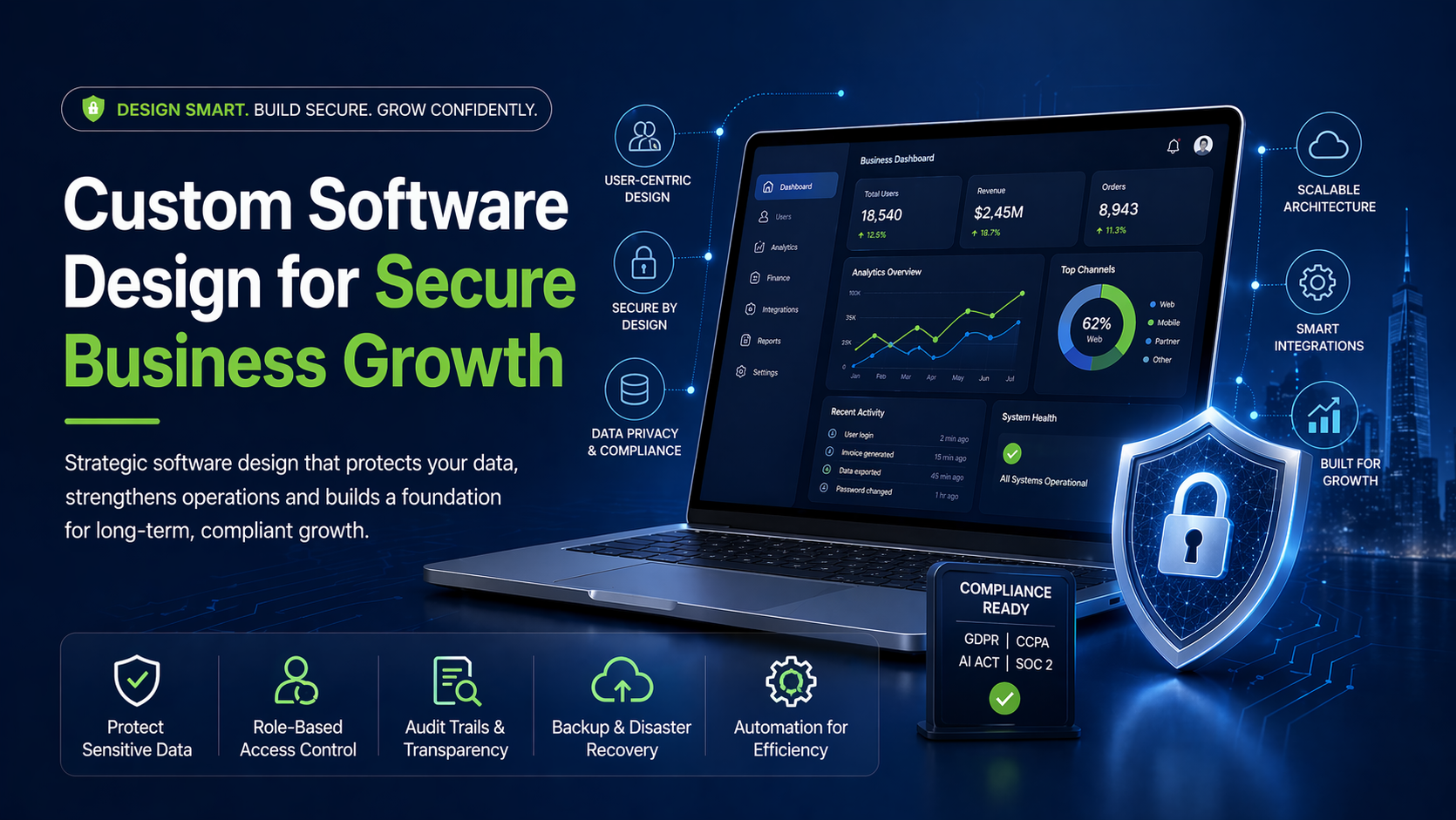
    A business application should be designed with clear user permissions, data access limits, audit trails, secure authentication, consent handling, backup planning, and role-based workflows. These are not just technical details. They help protect the business from avoidable risk.

    Why AI makes software design more sensitive

    AI is now becoming part of everyday business software. Companies want AI chat support, automated document review, smart reporting, workflow suggestions, lead scoring, fraud alerts, and predictive analytics. But AI also changes the risk profile of an application.

    IBM’s 2025 Cost of a Data Breach research found that 63% of breached organizations studied lacked AI governance policies, while only 37% had approval processes or oversight mechanisms in place.

    That is a major warning for businesses adopting AI quickly. If AI features are added without proper design controls, companies may lose visibility over how data is being used, who can access it, what outputs are generated, and whether sensitive information is exposed.

    Good custom software design should answer these questions before development begins:

    What data will the AI feature access?

    Who is allowed to use it?

    Should outputs be reviewed before action?

    Is customer or employee data involved?

    Can the system track activity for audits?

    Is there a way to disable or limit AI features if needed?

    These questions matter because AI is not just another feature. It can influence decisions, process sensitive data, and create compliance responsibilities. For business software, AI must be designed with control, not just convenience.

    Security-by-design is no longer optional

    Cybersecurity is now one of the strongest reasons companies invest in better software planning. The old approach was to build the application first and test security later. That approach no longer works well because modern applications are too connected, data-heavy, and exposed to fast-changing threats.

    A 2025 data breach report summary noted that a DevSecOps approach to software development was the number one factor that reduced breach costs, with AI and machine-learning insights and SIEM platforms also listed among the top cost-reducing factors. The same report stated that 97% of AI-related security breaches involved AI systems that lacked proper access controls.

    This shows why design must include security from the beginning. A business application should not wait until final testing to think about access control, user roles, secure coding, data protection, and monitoring.

    Security-by-design means the application is planned around protection from the start. It includes secure login systems, multi-factor authentication where needed, limited user permissions, encrypted data handling, secure APIs, activity logs, backup recovery, and clear admin controls.

    For Enter and Post LLC, this is an important trust-building point. Many businesses do not need complicated technical explanations. They need a partner that can explain how the system will protect business data, reduce manual risk, and support long-term reliability.

    Why user experience still matters, but differently

    User experience is still important, but in 2026 it is not only about making software easy to use. It is also about reducing mistakes.

    A confusing dashboard can cause employees to enter the wrong data. A weak approval process can allow unauthorized actions. A poorly designed customer portal can increase support requests. A bad reporting screen can lead managers to make decisions based on incomplete information.

    This is why custom software design should focus on business behavior. The designer must understand how people actually work inside the company.

    For example, an accounting team may need fast access to invoices, payment status, client documents, and approval history. A manager may need a high-level dashboard with alerts and exceptions. A customer may only need to upload files, check status, and receive updates. If all users see the same cluttered interface, the software becomes harder to use and easier to misuse.

    A good design separates user roles clearly. It gives each person the right tools, the right data, and the right level of access. This improves productivity and also supports security.

    Why generic software often fails operationally

    Many companies start with off-the-shelf tools because they are fast to set up. That can work for basic needs. But as the business grows, generic software often creates limitations.

    A company may end up using one tool for customer records, another for invoices, another for employee tasks, another for document storage, and another for reporting. Over time, employees begin copying data between systems manually. That creates errors, delays, and duplicate work.

    Custom systems solve this by matching the company’s real workflow. The design can connect departments, automate repetitive steps, and reduce dependency on scattered spreadsheets.

    This is especially useful for accounting, bookkeeping, HR, payroll, logistics, healthcare, service businesses, and companies with repeatable internal processes.

    For example, a business may need a client portal where customers upload documents, the accounting team reviews them, managers approve work, and reports are generated automatically. A generic tool may handle part of this process, but a custom system can bring the full workflow into one controlled environment.

    That is where Enter and Post LLC can stand out by connecting software design with real business operations, not just application screens.

    The cost of weak design appears later

    Poor design often looks cheaper in the beginning. A business may skip planning, reduce testing, avoid documentation, or build features quickly without thinking about future needs. But the cost usually appears later.

    Weak design can create:

    expensive rebuilds

    slow performance

    security gaps

    poor user adoption

    broken integrations

    duplicate manual work

    compliance problems

    confusing reporting

    limited scalability

    The real problem is that these issues often appear after the business has already invested money, trained staff, and started using the system. Fixing a live system is usually harder than designing it correctly from the start.

    That is why companies should view design as risk prevention. Better planning may take more effort upfront, but it can reduce long-term costs and operational disruption.

    What a secure design process should include

    A practical software design process should begin with discovery. This means understanding the company’s workflow, users, data, risks, integrations, and business goals. Without this step, the project may solve the wrong problem.

    After discovery, the team should map user roles. This includes admins, employees, managers, customers, vendors, finance teams, or any other user group. Each role should have clear permissions and responsibilities.

    Then comes workflow design. This step defines how information moves through the system. For example, who submits a request, who approves it, who receives notifications, what happens after approval, and where the record is stored.

    Next is data design. This includes what information is collected, where it is stored, how long it is kept, and who can access it. For regulated or sensitive industries, this step is extremely important.

    Then comes interface design. The screen layout should support the real task, not just look modern. A good interface reduces clicks, prevents confusion, and makes important actions clear.

    Finally, testing and review should happen before full development or launch. The business should review whether the design matches real work before the system becomes expensive to change.

    Why compliance-friendly software helps global companies

    A company targeting both USA and global customers needs to think beyond one market. Privacy and data rules differ by region. AI-related compliance is also developing quickly. Cybersecurity expectations are rising across industries.

    The EU entered a major digital-policy year in 2026, with significant developments expected around data protection, AI governance, cybersecurity regulation, cyber-resilience obligations, and privacy transparency.

    This does not mean every small business needs an enterprise-level legal system. But it does mean business software should be designed with flexibility. If the company grows into new markets, adds AI features, hires remote teams, or collects more sensitive data, the software should not collapse under new requirements.

    Compliance-friendly design includes clear data structures, permission management, logs, documentation, consent handling, and the ability to update policies or workflows without rebuilding the entire system.

    Why design documentation matters

    Many businesses overlook documentation because they want to move quickly. But documentation is one of the most practical ways to protect a software investment.

    Good documentation explains what the system does, how users interact with it, what data is collected, what integrations exist, and how different roles are managed. It also helps future developers maintain or improve the system.

    Without documentation, a company becomes dependent on memory, assumptions, or one developer’s knowledge. This creates risk if the original developer leaves, the vendor changes, or the system needs major updates later.

    For business software, documentation should not be treated as extra work. It is part of the product’s long-term value.

    How businesses should choose a design partner

    Choosing a software design partner should not be based only on portfolio appearance. A beautiful portfolio does not always mean the company understands business operations, compliance, security, or scalability.

    A strong design partner should ask about business goals, user roles, data sensitivity, integrations, reporting needs, internal approval flows, and future growth. They should also be willing to challenge unnecessary features.

    If a provider immediately agrees to every feature without asking why it matters, that can be a warning sign. Good software partners help businesses prioritize. They know that a smaller, focused version one is often more useful than a large, confusing system that takes too long to launch.

    Businesses should look for a partner that can explain design choices in simple business terms. The conversation should not be only about screens, colors, or technology stacks. It should also cover risk, efficiency, security, and long-term maintenance.

    Where Enter and Post LLC fits in

    The strongest opportunity for Enter and Post LLC is to position software design as part of business improvement. Many companies do not only need an app. They need a smarter way to manage customers, documents, accounting tasks, employee workflows, reporting, and operational communication.

    A custom application can help reduce manual effort, improve accuracy, protect sensitive data, and give managers better visibility. But the success of that application depends on how well it is designed before development begins.

    This is why businesses should work with a team that understands both software and practical business processes. When design is connected to real operations, the final product becomes easier to use, easier to manage, and more valuable over time.

    The future of custom software design

    The future of software design will be shaped by AI governance, secure-by-design development, cloud-native systems, automation, privacy expectations, and business-specific workflows. Companies will not be satisfied with generic systems that only perform basic tasks. They will want software that supports growth, protects data, and adapts to changing business needs.

    For USA and global companies, the main question is no longer “Can this software be built?” The better question is “Can this software be trusted, scaled, maintained, and used safely?”

    That is the difference between basic development and strategic software design.

    Conclusion

    Custom software design in 2026 is about much more than appearance. It is about building business systems that are secure, compliant, practical, and ready for growth. A well-designed application can improve workflow speed, reduce manual errors, protect sensitive information, support AI features responsibly, and make daily operations easier for teams and customers.

    Businesses that rush the design stage may save time at the beginning but face higher costs later. Businesses that invest in strong planning, clear user roles, security controls, compliance awareness, and scalable workflows are more likely to build software that creates long-term value.

    If your business needs a secure custom application, client portal, internal dashboard, workflow automation system, or practical digital solution, Enter and Post LLC can help you plan and design software around real business needs.

    CTA

    Ready to design software that supports growth and protects your business? Contact Enter and Post LLC today to discuss your custom software project and build a solution made for real operations, real users, and real results.

  • Custom Android App Development: Building Business Apps Around Real Users, Workflows, and Growth

    custom-android-app-development

    Why custom Android apps need a business-first angle

    Custom android app development is not simply about making an app that you can put on Google Play. Business require Android apps in 2026 that solve actual operational issues, help customers, improve internal procedures and make getting to services easier.

    What a custom Android app can genuinely achieve for a business The thing is Android continues to be an important platform worldwide. Android is still the global leader as StatCounter measures the market share of mobile operating systems using more than 3 billion monthly page visits. Business of Apps also says that Google Play is the world’s biggest app store in terms of quantity of apps and downloads, accounting for nearly half of all app downloads worldwide.

    That’s why Android is important. If you have USA and global consumers in your organization, Android apps can help you get broad reach across countries, devices and customer segments.

    Why companies choose “Android first”

    Many businesses prefer Android due of the huge mobile audience it offers. This is particularly true for Android, used by companies with clients in a wide range of regions, pricing groups and device kinds.

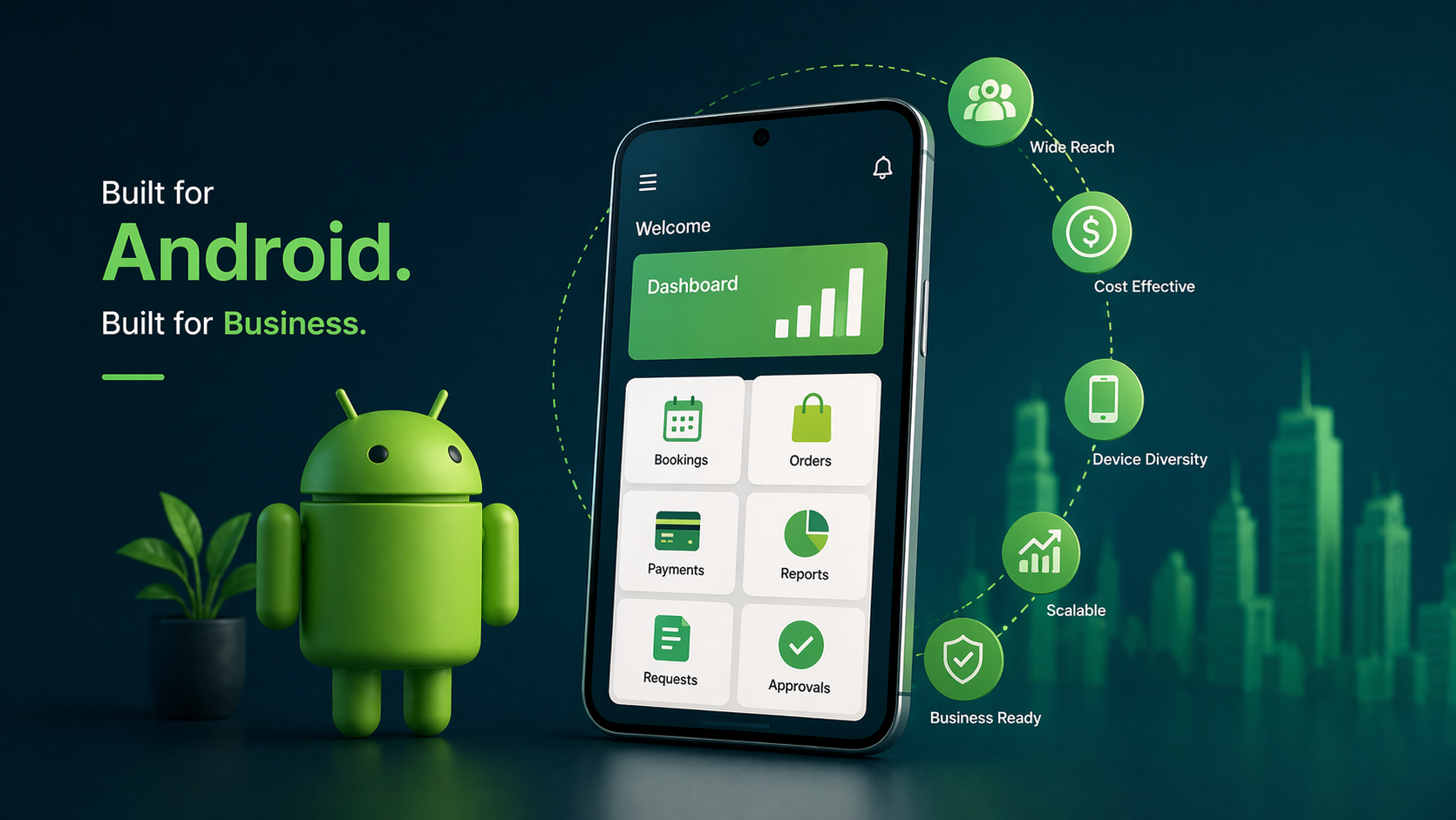
    You might have a business that needs an app for customer bookings, document uploads, service requests, payments, order tracking, staff reports, field operations or internal approvals. For many of these scenarios, Android can be a good place to start, because lots of people currently use Android phones for their daily digital activities.

    Enter and Post LLC might view Android app development as more than a mobile service. You might think of it as a technique to bring business activities closer to customers and staff.

    The bespoke Android app makes the business more accessible, easy to handle and convenient for use.

    What makes a bespoke android app special

    An app that is general may include basic displays and typical functionalities. A bespoke Android app is built around the actual workflow of the firm.

    For example, an accounting company can ask its clients to upload tax papers, check the status of their invoices and get reminders. Appointment booking, patient updates and secure communication are services healthcare providers may require. A logistics company may want driver updates, delivery tracking, route status and proof of delivery. Booking, payment status, customer notes, job updates may be needed in a service firm.

    Rather than forcing the business to fit into a generic tool, a custom application can be tailored around these particular demands.

    This is where bespoke android app development comes in. But the app is not Android only. It’s designed for the business process underlying the Android screen.

    Android apps enhance client convenience

    Customers desire speed. They want to book, pay, upload, message, track and get updates without waiting for a manual response.

    A bespoke Android app offers a direct platform for clients to communicate with the business. They may access the app, do the task and receive updates all in one place.

    This is useful for service companies, accounting firms, repair companies, shipping companies, healthcare providers, retail brands and professional service companies.

    A consumer might need to upload documents with a service request. Without an app, they will email files, forget critical facts, or call the office for updates. They can submit files, view missing items, monitor status and receive notifications through a custom Android app.

    This improves the customer experience and minimises burden on your internal personnel.

    Employees can also use Android applications

    A custom Android app isn’t necessarily customer-facing. A lot of firms want internal Android apps for their employees, managers, field teams, sales personnel and operations teams.

    An employee app enables staff to update job status, submit reports, upload images, get approvals, check schedules, view tasks, connect with supervisors and access dashboards from any location.

    This can be especially valuable for firms that have mobile teams, remote workers, delivery crew, service technicians, sales representatives, or various locations.

    Updates can be collected in real time by the firm instead of employees waiting to get back to a desk. This means better visibility and less wait time.

    Enter and Post LLC may also assist firms in planning Android apps to boost consumer experience and internal productivity.

    Retention is more important than downloads

    Publishing an android app is just a start. The true challenge is getting the people to keep using it.

    According to Business of Apps, app retention still poses a problem, with over 90% of users abandoning an app before 30 days across the board in 2026.

    Businesses should not build an app just for the sake of downloads. Their app has to give people a cause to come back.

    That reason could be convenience, speed of service, clear updates, secure access, document monitoring, payment status, appointment reminders, loyalty rewards, or easier communication.

    Your custom Android app should solve a real problem. If the program does not make life easier for the user, it would not produce long term value.

    The value of simplicity in Android app design

    Android users can utilise an app on many types of devices, screen sizes and internet circumstances. That makes basic design a premium.

    A business app should not overwhelm the user with too many screens, extensive forms, confusing buttons or functionality they don’t need. The key action needs to be easy on the app.

    For a client app the main functionalities would be to book, upload documents, monitor status, pay or contact support. For an employee app, the major actions could be task updates, approvals, reporting or communication. The major features for a manager app might include dashboards, notifications and performance tracking.

    Design should be frictionless. It helps people get things done faster.

    So, Enter and Post LLC should be leading clients to meaningful app design, not feature-heavy design.

    Device variety has to be prepared for from the beginning

    Android is a big ecosystem but that also brings complexity. Users can have different phones, different screen sizes, different OS versions, varied hardware performance and network speed.

    This truth demands the development of a specialised Android app. It must load quickly, use resources efficiently, handle poor connections, display accurately on various devices, and avoid causing additional performance issues.

    Testing is vital since an app that looks good on one device might not look good on another. A good development process tests in real user conditions, not just in perfect demo conditions.

    This important to firms because poor performance can eat away at trust. If customers can’t make a booking or staff can’t update, the app fails its function.

    Security is key for Android custom apps

    Many Android apps work with sensitive data. This can include customer records, employee data, payment information, company documents, uploaded files, location information, or private messaging.

    A secure custom Android app must have robust login, role-based access, encrypted communication, secure APIs, safe data storage, protected file uploads, and regular updates.

    Security planning should be done upfront before development. It should not be added after the app is already constructed.

    This is especially true in accounting, HR, payroll, healthcare, logistics, financial services, and professional service firms.

    Enter and Post LLC may build trust by guiding clients on how to design Android apps with practical security and appropriate data handling.

    What to include in a custom Android app

    A bespoke Android app should contain only those elements that contribute to achieving the business goal. The right features vary by firm, user and workflow.

    A consumer facing Android app could include:

    account login profile settings

    booking an appointment document upload payment tracking

    order or delivery status

    push-notifications

    customer support encrypted messaging

    feedback forms

    Android internal app may include:

    Employee Log In

    job distribution

    job state change

    image uploads

    asks for approval

    Management Dashboards

    field report or attendance

    inventory updates

    real-time alerts

    reports of performance

    The idea is not to have everything in at launch. The idea is to provide what the users need most.

    Why version one has to maintain focus

    One of the biggest pitfalls in Android app development is to attempt and build too much in the first edition.

    Booking, payments, chat, AI features, analytics, loyalty rewards, document uploads, admin dashboards, offline mode, various integrations – a business can want it all. Some of them might be important down the road, but developing everything upfront can increase expense, delay launch and confuse users.

    A more sensible strategy is to create the basic version first.

    Example: Version one may have login, booking, upload documents, track status, notifications, admin controls, etc. As real consumers start using the app, the firm may determine what to build next.

    It’s a gradual strategy that helps conserve the budget and improve the app based on real behavior.”

    Getting ready for a Google Play launch

    Publishing your app on Google Play is more than just uploading a file. The app should have an appropriate name, description, screenshots, category, privacy information, content rating, testing and policy compliance.

    The app listing must properly describe what the app accomplishes. Users should know the value before download.

    A solid launch plan should incorporate analytics, crash tracking, user feedback collection and update planning.

    Google Play competition is serious because users already have many app choices. If you’re going to build a bespoke Android app, it needs to have a clear objective and a great initial experience.

    Where Enter and Post LLC fits in

    Enter and Post LLC can position itself as a practical partner for businesses that need custom Android apps built around real operations.

    Many companies do not need an app filled with unnecessary features. They need an Android app that helps customers take action, employees work faster, managers see better data, and operations run with fewer delays.

    Enter and Post LLC can help businesses plan, design, and develop Android apps for customer portals, service booking, document uploads, payment tracking, internal approvals, field reporting, employee workflows, ecommerce support, and business dashboards.

    The strongest message is simple: Enter and Post LLC builds Android app solutions around real business needs, not generic templates.

    Why custom Android apps support business growth

    A custom Android app can help a business grow by improving access, speed, communication, and workflow control.

    Customers can complete tasks faster. Employees can update work from anywhere. Managers can see progress more clearly. Teams can reduce manual follow-ups. Businesses can collect better data and improve customer service.

    This is what makes Android app development valuable. It is not only about having an app. It is about using the app to make business easier to run.

    When planned properly, a custom Android app becomes a business system in the customer’s pocket.

    Conclusion

    Custom android app development helps businesses build mobile solutions around real users, real workflows, and real operational needs. Android offers broad market reach, but success depends on more than launching an app on Google Play.

    A strong Android app should be useful, simple, secure, fast, and designed around the actions customers or employees need most. It should not be overloaded in the first version. It should launch with a clear purpose and improve over time based on real user behavior.

    If your business needs a customer app, service booking app, document upload system, internal operations app, employee reporting tool, ecommerce app, or Android workflow solution, Enter and Post LLC can help plan and develop a practical app built around your business goals.

    CTA

    Ready to build a custom Android app that supports real users and real business growth? Contact Enter and Post LLC today to discuss your project and create an Android app designed for usability, performance, security, and long-term value.

  • Android App Development Agency: Why Businesses Need the Right Android Partner in 2026

    android app development agency

    Hiring an android app development agency in 2026 is not similar to hiring a regular software team to produce a simple mobile app. Android has its own market dynamics, device ecosystem, app store restrictions, performance issues, security demands and user expectations.

    Android continues to be the world’s leading mobile operating system. StatCounter measures the global market share of mobile operating systems using more than 3 billion monthly page views, and Android is still the largest mobile OS internationally. Business of Apps also calls Google Play the biggest app store by the number of apps and downloads, accounting for over half of all app downloads globally.

    Android is important because it has reach. For companies with USA and international consumers, Android is a massive platform for reaching broad audiences in North America, Asia, Africa, Latin America, the Middle East and Europe.

    Android is not one device market not only

    Device variety is a major reason firms need a comprehensive Android strategy. Not all Android users have the same phone, screen size, chipset, OS version, or network situation.

    An app that works great on a premium handset may not work so great on a lower-cost device. What looks clean on one phone can feel cluttered on another. Fast internet makes things go off without a hitch. Weaker internet might be frustrating.

    That’s why Android development needs more than brilliant design. It requires planning for performance, testing on devices, efficient coding, cautious memory utilisation and user experience considerations based on real-world Android behaviour.

    A competent agency will get this from the outset. The goal is to produce more than an app that gets launched. The goal is to design an app that works dependably for the clients who actually use it.

    Why Google Play rivalry is serious

    The Android app market has a lot of competition. AppBrain routinely refreshes its Google Play statistics, which monitor the number of Android apps available over time, including new app launches and apps withdrawn from Google Play.

    That suggests that the competition is not taking place in a vacuum. Users have plenty of app options already. A new app has to be useful, speedy, trustworthy and easy to understand.

    An app that isn’t that great might get downloaded once and never used again. A good app provides people a reason to come back. Perhaps for speedier service, account access, order monitoring, document uploading, appointment scheduling, payments, support, loyalty benefits, internal approvals or business reporting.

    This is a good placement point for Enter and Post LLC. Most important is to position Android app development not as a technical solution but as a business growth instrument.

    Why do firms use an Android agency?

    There are many companies who don’t have their own Android team. Even if you have a website or software system, you need specific expertise to create for Android.

    A competent android app development agency may assist in product planning, UI and UX design, Android development, backend programming, API integration, database setup, Google Play submission, testing, analytics, security, and post-launch support.

    This is important since a mobile app is not a single, isolated screen. Typically it requires a backend system, admin panel, secure login, user database, notifications, payment gateway, reporting dashboard, third-party integrations and support tools.

    A service business may require clients to schedule appointments and upload files. Secure file sharing for an accounting organization. A retail organization may need to provide browsing of products, cart, checkout, and order tracking. The delivery updates and route status may need a logistics business. A healthcare business might need appointment reminders, and secure patient communication.

    The android app is just the front layer. The actual worth is in the whole system underlying it.

    Android consumers want speed and simplicity

    Mobile consumers don’t have patience. If an app is slow, unclear or overloaded, people leave. This is especially true for Android as users have access to apps on numerous sorts of devices and network speeds.

    Good Android design should put the most critical things front and center. Customers shouldn’t have to think too much before booking, uploading, paying, checking status or contacting support.

    A business app should not have a lot of screens, heavy animations, confusing menus, extensive forms and imprecise buttons. The app should organically lead the user to the action they need.

    This is where we need agency experience. A good agency doesn’t just enquire what screens the client wants. It looks at the user journey and asks what does the consumer need to do, fast.

    AI is shifting expectations for Android apps

    Mobile App Development is now being influenced by AI. Users are learning about AI-powered search, smart recommendations, AI chat help, document summarisation, voice tools and personalisation.

    A recent report on India’s mobile app business indicated that app revenue grew 33% year over year to $300 million in Q1 2026, thanks to AI-driven apps and increase of short-form content. It highlights how AI capabilities are increasingly embedded into mobile engagement and monetisation, especially in fast-growing Android-heavy regions.

    But you should not include AI just because it is AI. An Android app should only employ AI if it adds value to the user experience or business workflow.

    AI can help summarise documents, recommend items, answer common enquiries, catch missing information, personalise material, or help internal teams. But it requires excellent data, appropriate permissions, solid security and clear boundaries.

    A beneficial organization would help firms figure out where AI is useful, and where it isn’t.

    Security in Android application development

    Android apps commonly deal with personal data, payment information, client files, employee records, company documents, location data, messaging, and account access. Which implies security has to be included into the project from day one.

    A secure Android app might need robust authentication, role-based access, encrypted communication, secure APIs, safe data storage, regulated permissions, and regular updates.

    Security is especially crucial for accounting, HR, payroll, healthcare, logistics, financial services and professional service apps. If an app handles sensitive information, poor preparation might create corporate risk.

    This is a strong message to Enter and Post LLC. Businesses need more than a pretty looking app. “They are looking for an app that protects users and supports real operations.”

    Testing is a necessary in Android development

    Testing is one of the greatest difference between a simple mobile app project and a real Android project.

    Android is used on a wide range of devices, thus testing should include screen sizes, operating system versions, device performance, network circumstances, login flows, forms, alerts, payment processes, permissions, and error handling.

    An app can work in a demo but not when real users try it in varied settings. Therefore, testing should not be considered as a final formality. It should take place in the development and before the launch.

    A good agency will also arrange for post-launch monitoring. Real users will expose problems that may not show up in a controlled test environment.

    Strategy includes a Google Play launch

    Publishing apps on Google Play is not a technical upload. The app needs to have a correct store listing, screenshots, description, category selection, privacy information, content rating, testing and policy compliance.

    Google Play has its own quality objectives and policy regulations. Apps that don’t satisfy our requirements may be rejected or delayed. Companies need to partner with an agency that knows how to launch and can have the app ready to go.

    The plan should involve app store optimisation, analytics setup, user feedback tracking, crash monitoring, and update planning.

    But the debut will not be the end of the effort. This is the beginning of real user learning.

    Why You Should Not Overengineer The First Android App

    It’s a classic mistake to try to cram all conceivable functionality into the first release. This frequently adds costs, delays launch and makes the software tougher to use.

    It is advisable to construct the core version first. The first version must solve the core user problem convincingly.

    For example, a first version might have login, profile, booking, document upload, notifications, payment status, and rudimentary support. Later versions might incorporate AI chat, enhanced analytics, loyalty rewards, offline mode, deeper integrations or personalised dashboards.

    This tiered strategy gives organisations the ability to control costs and enhance the app depending on actual user behaviour.

    What should a good Android app project have

    Discovery should be the first step in any major android app project. The agency should know the business strategy, users, app goals, workflows, features needed, data needed, security needs, and long term ambitions.

    Then planning. This involves deciding on features for version one and what can wait.

    Design is an Android user behaviour, navigation, accessibility, speed and easy operations. Development should comprise frontend Android, backend systems, APIs, database setup, admin panels, notifications and integrations.

    Testing should be across devices and real world user scenarios. Once launched, the app will need upgrades, bug fixes, analytics evaluation, performance enhancements, security patches and planning for new features.

    That’s what makes a true Android partner different from a simple code vendor.

    Location of Enter and Post LLC

    Enter and Post LLC can present itself as a viable partner for Android app development for businesses wishing to have mobile apps tied to real activities.

    Many firms do not require an app with unneeded functionality. They need an Android app that lets customers get things done, helps workers work faster and provides management better visibility.

    An Android app may handle customer portals, schedule appointments, upload documents, track payments, service requests, notifications, reports, internal approvals and manage mobile workflow.

    Properly planned Android development is not just an app icon on a phone. It’s a business system.

    Abstract

    Hiring an android app development agency in 2026 is not just producing an app for Google Play. It’s about building a mobile experience that works across devices, supports actual users, secures sensitive data, links with business systems, and can get better over time.

    Android offers organisations a huge worldwide audience, but that opportunity is accompanied with competition, device diversity, security expectations and retention issues.

    To build a successful Android app, companies should consider user requirements, easy design, high performance, safe architecture, thorough testing, and refinement after launch.

    If your business need an Android app for customers, employees, service booking, document uploads, ecommerce, reporting or workflow automation, Enter and Post LLC can assist plan and develop a solution built on genuine business goals.

    CTA

    Ready to create an Android app that supports real customers and real business growth? Get in touch with Enter and Post LLC immediately to discuss your Android app project and develop a solution tailored for performance, usability, and lasting value.

  • Healthcare Software Development Services: Strengthening Compliance, Efficiency, and Financial Clarity for U.S. Healthcare Businesses

    Healthcare Software Development Services

    Introduction: Why Healthcare Businesses Need Specialized Digital Solutions

    Healthcare is one of the most regulated and operationally complex industries in the United States. From patient data security and billing accuracy to payroll compliance and financial reporting, healthcare organizations face unique challenges that require more than generic software tools.

    This is where healthcare software development services become essential.

    Small and medium-sized healthcare providers—including private practices, specialty clinics, home healthcare agencies, telehealth startups, and multi-location service providers—must balance patient care with administrative efficiency. Without integrated digital systems, operational inefficiencies quickly lead to billing errors, compliance risks, payroll inconsistencies, and financial blind spots.

    Healthcare software development services allow organizations to build tailored, secure, and scalable systems that support both clinical operations and financial management.

    At Enter And Post LLC, we help healthcare businesses align digital infrastructure with bookkeeping, payroll, HR compliance, and back-office operations—ensuring technology strengthens both patient service and financial clarity.

    What Are Healthcare Software Development Services?

    Healthcare software development services involve the design, development, and integration of customized digital solutions specifically for healthcare providers and organizations.

    These services may include:

    Electronic health record (EHR) enhancements

    Patient portals

    Appointment scheduling systems

    Medical billing and claims automation

    Telehealth platforms

    Payroll and HR integration systems

    Compliance tracking tools

    Financial reporting dashboards

    Workflow automation systems

    Unlike generic software development, healthcare software development services must account for strict regulatory standards, sensitive patient data handling, and complex billing structures.

    For U.S.-based healthcare SMBs, precision and compliance are non-negotiable.

    Why Off-the-Shelf Solutions Often Fall Short in Healthcare

    Many small healthcare providers initially adopt basic software platforms to manage appointments, billing, or payroll. However, as patient volume grows and compliance requirements increase, limitations become clear.

    1. Fragmented Systems

    Billing software may not integrate with accounting platforms. Payroll systems may not align with time-tracking for clinical staff. Reporting tools may lack real-time financial visibility.

    Disconnected systems lead to administrative burden and reporting delays.

    2. Compliance Gaps

    Healthcare providers must maintain strict data security and documentation standards. Generic platforms may lack necessary customization to track audit logs, manage permissions, and maintain proper reporting.

    3. Limited Financial Insight

    Healthcare businesses often struggle with:

    Delayed revenue recognition

    Inconsistent cash flow reporting

    Claims processing delays

    Expense tracking inaccuracies

    Healthcare software development services create systems that integrate financial reporting with operational data.

    The Strategic Benefits of Healthcare Software Development Services

    Enhanced Compliance and Security

    Healthcare organizations handle highly sensitive data. Secure healthcare software development services focus on:

    Role-based access controls

    Secure cloud environments

    Data encryption

    Audit-ready reporting

    Secure document storage

    Strong system architecture reduces compliance risk and strengthens trust.

    Improved Billing and Revenue Cycle Management

    Revenue cycle management is central to healthcare financial health.

    Custom healthcare software development services can:

    Automate insurance claims tracking

    Reduce billing errors

    Sync patient billing with accounting systems

    Improve reimbursement tracking

    Generate real-time revenue dashboards

    Accurate billing directly improves cash flow management.

    Payroll and Workforce Management Integration

    Healthcare staffing is complex. Providers often manage:

    Hourly staff

    Salaried clinicians

    Contractors

    Overtime shifts

    Multi-location teams

    Healthcare software development services can integrate:

    Time tracking systems

    Payroll automation platforms

    HR documentation tools

    Benefits tracking

    Multi-state payroll compliance

    Accurate payroll processing protects against regulatory penalties and employee dissatisfaction.

    Real-World Example: Modernizing a Multi-Location Clinic

    A regional healthcare clinic operating across three locations faced growing challenges:

    Manual claims tracking

    Delayed billing reconciliation

    Separate payroll and HR systems

    Limited financial reporting visibility

    Inconsistent time tracking

    Administrative staff spent excessive hours reconciling data between systems.

    After implementing customized healthcare software development services, the clinic achieved:

    Automated billing integration with accounting systems

    Centralized HR and payroll processing

    Real-time financial dashboards

    Improved cash flow forecasting

    Reduced administrative workload by 30%

    This transformation strengthened both compliance and profitability.

    Healthcare Software Development Services and Financial Clarity

    Financial clarity is essential for sustainable healthcare growth.

    Custom systems can provide:

    Department-level profitability tracking

    Revenue cycle reporting

    Expense monitoring by service line

    Cash flow management dashboards

    Automated reconciliation tools

    Budget forecasting systems

    Financial management systems for healthcare SMBs must align operational data with bookkeeping standards.

    Enter And Post LLC ensures digital solutions support accurate financial reporting and streamlined accounting processes.

    Supporting Telehealth and Digital Care Models

    Telehealth expansion has increased demand for secure, scalable platforms.

    Healthcare software development services for telehealth may include:

    Secure video integration

    Appointment scheduling automation

    Digital patient intake forms

    Secure payment processing

    Integrated billing systems

    As virtual care continues to grow, scalable infrastructure becomes critical.

    Business Process Optimization in Healthcare

    Healthcare organizations face high administrative demands.

    Business process optimization services through custom development can:

    Automate patient onboarding

    Streamline documentation workflows

    Reduce manual data entry

    Improve claims submission accuracy

    Centralize back-office support

    Automation improves efficiency while allowing staff to focus on patient care.

    Long-Tail Keywords Naturally Integrated

    This guide addresses key search topics such as:

    Healthcare software development services for small practices

    Custom healthcare software solutions

    Medical billing software integration

    Healthcare payroll system automation

    Financial management systems for clinics

    Healthcare digital transformation services

    These reflect real operational concerns for healthcare providers.

    Common Challenges in Healthcare Software Development

    Regulatory Complexity

    Healthcare systems must meet strict documentation and reporting standards.

    Integration with Existing Systems

    New solutions must align with existing EHR, billing, and accounting systems.

    Data Security Risks

    Cybersecurity threats make secure system architecture essential.

    Scalability Planning

    Healthcare practices often expand through new locations or service lines. Systems must accommodate growth.

    Strategic healthcare software development services address these challenges through careful planning and integration.

    Why Healthcare SMBs Partner with Enter And Post LLC

    Enter And Post LLC is a U.S.-based professional services firm specializing in:

    Bookkeeping and accounting services

    Payroll and HR solutions

    Back-office operations support

    Web development and digital solutions

    Business process optimization

    We understand that healthcare software development services must align with:

    Financial reporting standards

    Payroll compliance requirements

    Revenue cycle management

    Secure operational workflows

    Scalable digital infrastructure

    Our approach includes:

    Comprehensive workflow analysis

    Financial system alignment

    Compliance-focused development

    Secure data management

    Integration with payroll and accounting systems

    We ensure technology strengthens operational performance without compromising compliance or financial clarity.

    The Long-Term Value of Healthcare Software Development Services

    Healthcare providers operate in a high-pressure environment where accuracy and compliance are critical.

    Investing in professional healthcare software development services supports:

    Reduced billing errors

    Faster reimbursements

    Improved payroll accuracy

    Enhanced compliance tracking

    Greater financial transparency

    Scalable operational infrastructure

    Digital modernization is not optional for growing healthcare organizations—it is a strategic necessity.

    Conclusion:

    Healthcare software development services play a vital role in strengthening compliance, improving billing accuracy, and enhancing operational efficiency for U.S. healthcare businesses.

    From secure patient data management and automated revenue cycle tracking to integrated payroll systems and financial reporting dashboards, customized solutions provide the foundation for scalable growth.

    When digital infrastructure aligns with bookkeeping, HR compliance, and back-office support, healthcare providers gain both operational control and financial clarity.

    Enter And Post LLC helps healthcare organizations implement secure, scalable systems that support patient care while strengthening business performance.

    Strengthen Your Healthcare Operations with Strategic Digital Solutions

    If your healthcare organization is facing administrative bottlenecks, billing inefficiencies, or limited financial visibility, it may be time to explore tailored healthcare software development services.

    Partner with Enter And Post LLC to streamline operations, improve compliance, and build integrated systems that support both patient care and long-term business growth. Contact our team today to begin modernizing your healthcare infrastructure with confidence.

  • How Software Development Projects Drive Efficiency and Scalable Growth for U.S. Businesses

    Software Development Projects

    Introduction: Why Software Development Projects Matter for Growing Businesses

    In today’s competitive business environment, small and medium-sized businesses (SMBs) cannot rely solely on manual processes, disconnected systems, or generic software tools. As operations expand, the need for well-planned software development projects becomes increasingly clear.

    Whether it’s automating payroll, integrating bookkeeping systems, building internal workflow tools, or creating client portals, software development projects play a direct role in improving operational efficiency and financial clarity.

    For U.S.-based businesses, the challenge is not just launching technology initiatives—it’s executing software development projects strategically so they align with compliance requirements, cash flow management, and long-term scalability.

    At Enter And Post LLC, we support SMBs by aligning digital solutions with accounting systems, payroll infrastructure, back-office operations, and business process optimization. Successful software development projects are not just technical upgrades—they are growth strategies.

    What Are Software Development Projects?

    Software development projects refer to structured initiatives designed to create, enhance, or integrate digital systems within a business. These projects can vary in scope, including:

    Custom internal workflow systems

    Payroll automation platforms

    Accounting integration tools

    Inventory management systems

    Financial reporting dashboards

    Client portals

    HR management systems

    Business automation tools

    Unlike simple software purchases, software development projects involve planning, design, development, testing, deployment, and ongoing optimization.

    For SMBs, each project must solve real operational challenges—not add unnecessary complexity.

    Why SMBs Invest in Software Development Projects

    As businesses grow, complexity increases. More employees, more transactions, more compliance requirements, and more reporting demands require better systems.

    Here are common reasons SMBs initiate software development projects:

    1. Manual Process Overload

    Spreadsheets, repetitive data entry, and disconnected tools slow productivity. Automation reduces errors and saves time.

    2. Payroll and HR Complexity

    Growing teams across multiple states require automated payroll systems with built-in compliance tracking.

    3. Lack of Financial Visibility

    Business owners need real-time financial reporting, profit tracking, and cash flow management tools.

    4. Operational Inefficiency

    Inefficient workflows create bottlenecks that restrict scalability.

    Strategic software development projects eliminate these challenges.

    The Strategic Benefits of Software Development Projects

    Operational Efficiency

    Well-executed software development projects streamline daily operations by:

    Automating bookkeeping entries

    Syncing payroll with accounting systems

    Centralizing HR documentation

    Reducing duplicate data entry

    Improving reporting accuracy

    Operational efficiency translates directly into lower administrative costs.

    Improved Financial Reporting

    Financial clarity is essential for sustainable growth.

    Custom financial management systems for SMBs allow businesses to:

    Generate real-time profit and loss statements

    Track departmental performance

    Monitor expenses

    Improve cash flow forecasting

    Strengthen audit trails

    Software development projects that prioritize financial reporting empower smarter decision-making.

    Stronger Compliance and Risk Reduction

    Compliance is one of the biggest risks for growing businesses.

    Software development projects can include:

    Payroll automation with tax compliance tracking

    Secure document storage for HR records

    Automated reporting tools

    Permission-based access controls

    Secure data encryption

    These features protect businesses from costly penalties and operational disruptions.

    Real-World Example: From Chaos to Control

    Consider a mid-sized service company managing operations in three states. Their systems included:

    Separate payroll software

    Manual time tracking

    Entry-level bookkeeping software

    Disconnected CRM

    Paper-based HR files

    As the company grew, errors increased. Payroll adjustments were frequent. Financial reporting was delayed. Compliance tracking became reactive.

    They launched a structured software development project focused on:

    Integrating payroll with accounting

    Implementing digital time tracking

    Automating invoicing

    Centralizing HR documentation

    Building real-time reporting dashboards

    Within months, they achieved:

    30% reduction in administrative workload

    Faster month-end close

    Improved compliance tracking

    Enhanced financial clarity

    This is the impact of strategic software development projects aligned with business operations.

    Common Types of Software Development Projects for SMBs

    1. Payroll Automation Systems

    Payroll system development projects focus on:

    Multi-state payroll processing

    Overtime tracking

    Benefits integration

    Direct accounting synchronization

    Automated compliance reporting

    Payroll automation for growing companies reduces risk and increases efficiency.

    2. Accounting and Bookkeeping Integration

    Software development projects often target financial system integration by:

    Automating transaction categorization

    Syncing bank feeds

    Generating custom financial dashboards

    Enhancing reporting accuracy

    Outsourced accounting and digital solutions must work together seamlessly.

    3. Business Process Automation

    Business process optimization services rely on software development projects to:

    Automate recurring tasks

    Centralize communication

    Reduce manual approvals

    Improve workflow tracking

    Automation increases productivity and reduces operational friction.

    4. Customer and Client Portals

    For service-based businesses and e-commerce companies, software development projects may include:

    Secure client dashboards

    Online payment integration

    Document sharing portals

    Order tracking systems

    Improved customer experience supports revenue growth.

    Key Phases of Successful Software Development Projects

    For SMBs, structured execution is critical.

    Phase 1: Discovery and Workflow Analysis

    Before development begins, businesses must evaluate:

    Existing processes

    Financial reporting requirements

    Payroll and HR needs

    Compliance risks

    Integration requirements

    Skipping this phase often leads to project failure.

    Phase 2: System Design and Planning

    During this stage, technical architecture aligns with:

    Accounting standards

    Payroll regulations

    Data security requirements

    Scalability planning

    Strong planning reduces future modification costs.

    Phase 3: Development and Integration

    This phase includes:

    Coding

    Testing

    Integration with bookkeeping systems

    Payroll synchronization

    Security implementation

    Testing ensures reliability before launch.

    Phase 4: Deployment and Optimization

    After launch, businesses should:

    Train staff

    Monitor performance

    Adjust workflows

    Improve reporting structures

    Software development projects require ongoing optimization to deliver full ROI.

    Cost Considerations in Software Development Projects

    Many SMB owners hesitate because of cost concerns.

    However, evaluating software development projects requires considering:

    Administrative labor costs

    Payroll errors

    Compliance penalties

    Delayed reporting

    Operational inefficiencies

    Lost growth opportunities

    Software development projects should be viewed as long-term investments in scalability and operational control.

    When properly executed, they reduce overhead and increase profitability.

    Long-Tail Keywords Naturally Integrated

    This guide addresses common search topics including:

    Software development projects for small business

    Custom software solutions for SMBs

    Payroll system development projects

    Accounting software integration projects

    Business process automation initiatives

    Digital transformation for growing companies

    These reflect the real challenges business owners face when modernizing operations.

    Common Mistakes in Software Development Projects

    Lack of Clear Objectives

    Projects fail when businesses do not define measurable outcomes.

    Ignoring Financial Integration

    Systems must align with bookkeeping and financial reporting.

    Underestimating Compliance Needs

    Payroll and HR systems require regulatory awareness.

    Poor Scalability Planning

    Technology must grow with your business.

    Avoiding these mistakes ensures successful implementation.

    Why Businesses Trust Enter And Post LLC

    Enter And Post LLC is a U.S.-based professional services company providing:

    Bookkeeping and accounting services

    Payroll and HR solutions

    Back-office operations support

    Web development and digital solutions

    Business process optimization

    We approach software development projects from a business-first perspective.

    Our methodology includes:

    Workflow analysis

    Financial alignment

    Compliance-focused design

    Secure system architecture

    Scalable infrastructure planning

    We ensure technology strengthens financial clarity, operational efficiency, and compliance management.

    The Future of Software Development Projects

    As digital transformation accelerates, software development projects will increasingly focus on:

    Real-time data synchronization

    AI-powered automation

    Enhanced financial dashboards

    Secure cloud-based operations

    Integrated payroll and HR systems

    SMBs that proactively invest in modernization gain competitive advantages in efficiency and scalability.

    Technology should empower leadership—not create confusion.

    Conclusion:

    Software development projects are not simply IT initiatives—they are strategic growth tools.

    For U.S.-based small and medium-sized businesses, well-planned projects improve operational efficiency, strengthen payroll and HR compliance, enhance financial reporting, and support long-term scalability.

    When aligned with bookkeeping systems, back-office support, and business process optimization, software development projects create sustainable operational infrastructure.

    Enter And Post LLC helps businesses plan and execute digital initiatives that improve clarity, reduce risk, and support confident growth.

    Move Your Business Forward with Strategic Digital Solutions

    If your current systems are limiting growth or creating inefficiencies, it may be time to consider structured software development projects tailored to your operations.

    Partner with Enter And Post LLC to streamline processes, strengthen financial management, and build scalable digital systems designed for long-term success. Connect with our team today to begin building smarter systems that support your business at every stage of growth.

  • Firmware Development: A Strategic Advantage for U.S. Businesses Building Smarter Systems

    Firmware Development

    Introduction: Why Firmware Development Matters for Modern Businesses

    As U.S. businesses continue integrating smart devices, automation tools, IoT equipment, and specialized hardware into their operations, firmware development has become a critical yet often overlooked component of digital transformation.

    Many small and medium-sized businesses (SMBs) focus on software systems like accounting platforms, payroll automation tools, and CRM systems. However, when your operations rely on physical devices—such as inventory scanners, smart manufacturing equipment, POS systems, tracking devices, or embedded controllers—firmware is what makes those devices function properly.

    Without reliable firmware development, even the most advanced hardware becomes inefficient, vulnerable, or incompatible with your broader digital ecosystem.

    At Enter And Post LLC, we help businesses integrate digital solutions with operational systems, financial infrastructure, and back-office processes. Firmware development plays an important role in creating seamless connections between hardware, software, bookkeeping systems, payroll tracking, and operational reporting.

    Understanding firmware development is essential for businesses seeking scalability, automation, and long-term operational efficiency.

    What Is Firmware Development?

    Firmware development refers to the process of designing and programming the low-level software embedded within hardware devices. Firmware acts as the bridge between hardware components and higher-level software systems.

    Unlike traditional application software, firmware:

    Is stored directly on hardware devices

    Controls device functionality

    Manages communication between hardware and software

    Supports system performance and stability

    Enables data transmission and automation

    Examples of where firmware development is used in SMB environments include:

    Smart inventory management systems

    Industrial automation equipment

    IoT-enabled tracking devices

    Retail POS terminals

    Payroll time-tracking hardware

    Security and access control systems

    For businesses investing in automation, firmware development ensures devices operate reliably, securely, and efficiently.

    Why Firmware Development Is Important for SMBs

    Many business owners assume firmware development is only relevant for large manufacturing corporations. In reality, SMBs increasingly rely on embedded systems in daily operations.

    1. Device Reliability

    When hardware fails due to outdated or poorly developed firmware, operations stop. In retail, this could mean POS downtime. In logistics, delayed tracking updates. In manufacturing, halted production.

    High-quality firmware development ensures stability and reliability.

    2. Integration with Business Systems

    Devices must communicate with:

    Accounting systems

    Inventory platforms

    Payroll systems

    HR software

    Financial reporting dashboards

    For example, a biometric time clock must sync accurately with payroll automation systems. Poor firmware can cause data inconsistencies, resulting in payroll errors and compliance risks.

    3. Security and Compliance

    Firmware vulnerabilities expose businesses to cybersecurity risks. Devices connected to financial systems or employee data must meet strict security standards.

    Secure firmware development helps:

    Protect payroll data

    Safeguard financial transactions

    Prevent unauthorized system access

    Support audit trails

    For U.S.-based SMBs handling sensitive financial and employee information, security is not optional.

    Real-World Business Example

    Consider a regional distribution company that implemented IoT-enabled tracking devices across its fleet. The hardware was advanced, but outdated firmware caused:

    Delayed GPS reporting

    Inaccurate mileage tracking

    System crashes

    Inconsistent data syncing with accounting software

    This led to billing discrepancies and flawed expense tracking in their bookkeeping system.

    After investing in professional firmware development and integration support, device data synchronized accurately with financial reporting dashboards. The company improved expense accuracy, reduced disputes, and strengthened cash flow management.

    This example highlights how firmware directly impacts financial clarity and operational efficiency.

    Firmware Development and Operational Efficiency

    Operational efficiency depends on accurate data flow between hardware and business systems.

    Strategic firmware development supports:

    Real-time inventory updates

    Automated time tracking

    Smart warehouse automation

    Equipment performance monitoring

    Integrated financial management systems

    When devices transmit reliable data, accounting systems generate accurate reports. Payroll automation runs smoothly. Back-office support becomes streamlined.

    Operational efficiency begins at the device level.

    Firmware Development and Digital Transformation

    Digital transformation is not limited to cloud software. It includes the modernization of hardware systems.

    Firmware development plays a critical role in:

    Updating legacy equipment

    Enabling remote device management

    Supporting cloud-based integrations

    Implementing IoT connectivity

    Improving system performance

    Businesses that ignore firmware modernization often experience integration challenges when implementing new accounting or payroll systems.

    At Enter And Post LLC, we ensure digital transformation initiatives align across hardware, software, and financial infrastructure.

    Cost Considerations in Firmware Development

    When evaluating firmware development, business owners often focus only on upfront cost.

    However, consider the broader financial impact:

    Downtime due to device failures

    Inaccurate payroll data from faulty time clocks

    Inventory shrinkage due to scanning errors

    Compliance risks from poor data logging

    Increased administrative overhead

    Firmware development cost must be evaluated against long-term operational savings.

    Investing in reliable embedded systems reduces risk and improves scalability.

    Firmware Development for Different Industries

    Manufacturing

    Firmware supports automated production lines, machine monitoring, and quality control tracking. Accurate data transmission improves cost accounting and financial forecasting.

    Retail

    POS systems, barcode scanners, and inventory tracking devices rely on firmware for smooth operation. Integration with bookkeeping systems ensures accurate revenue reporting.

    Logistics and Transportation

    Fleet tracking devices, fuel monitoring systems, and maintenance sensors depend on reliable firmware. Accurate data improves expense tracking and operational planning.

    Healthcare and Professional Services

    Access control systems, scheduling devices, and patient tracking tools must operate securely and efficiently. Firmware integrity supports compliance and data protection.

    Across industries, firmware development ensures device-level reliability supports broader business goals.

    Long-Tail Keywords Naturally Integrated

    This article addresses critical search topics such as:

    Firmware development services for small businesses

    Embedded systems development for SMBs

    IoT firmware development solutions

    Firmware security and compliance support

    Device integration with accounting systems

    Business automation through firmware

    These areas reflect growing demand for hardware-software integration among U.S. businesses.

    Common Firmware Development Challenges

    Legacy Systems

    Older equipment may lack compatibility with modern accounting or payroll software.

    Poor Documentation

    Many SMBs inherit hardware systems without clear firmware documentation, making upgrades difficult.

    Security Vulnerabilities

    Outdated firmware increases cybersecurity exposure.

    Scalability Issues

    Firmware not designed for growth can limit device expansion or integration with new systems.

    Addressing these challenges requires strategic planning and cross-functional expertise.

    The Role of Integration in Firmware Development

    Firmware must integrate seamlessly with:

    Financial reporting systems

    Payroll automation platforms

    Inventory management tools

    Back-office support systems

    Cloud-based dashboards

    Without integration, businesses face manual reconciliation processes that increase administrative burden.

    Enter And Post LLC approaches firmware development within the context of total business optimization. Devices must support—not complicate—accounting, payroll, and operational efficiency.

    Aligning Firmware Development with Financial Clarity

    Firmware may operate at the hardware level, but its impact reaches financial reporting.

    Reliable device data improves:

    Cost tracking

    Expense allocation

    Revenue recognition

    Inventory valuation

    Cash flow management

    Audit preparedness

    For growing SMBs, accurate financial management systems depend on accurate operational data.

    Firmware development is part of building a trustworthy financial foundation.

    Why Businesses Choose Enter And Post LLC

    Enter And Post LLC is a U.S.-based professional services firm providing:

    Bookkeeping and accounting services

    Payroll and HR solutions

    Back-office operations support

    Web development and digital solutions

    Business process optimization

    We understand that firmware development must align with broader operational goals.

    Our approach includes:

    Evaluating existing device infrastructure

    Assessing integration requirements

    Aligning firmware with financial reporting systems

    Supporting compliance-focused design

    Improving overall operational efficiency

    We do not treat firmware as an isolated technical component. We integrate it into your full business ecosystem.

    The Future of Firmware Development for SMBs

    As automation expands and IoT adoption increases, firmware development will become even more critical.

    Businesses that invest in reliable embedded systems gain:

    Better data accuracy

    Stronger compliance tracking

    Improved payroll integration

    Reduced downtime

    Enhanced scalability

    The future belongs to businesses that align hardware reliability with digital innovation and financial clarity.

    Conclusion:

    Firmware development is no longer just a technical consideration—it is a strategic business priority.

    For small and medium-sized businesses across the United States, embedded systems influence operational efficiency, payroll accuracy, financial reporting, and compliance management. Reliable firmware ensures hardware devices support—not disrupt—daily operations.

    When firmware development aligns with accounting systems, payroll automation, and business process optimization, it becomes a foundation for scalable growth.

  • Understanding Software Development Cost: A Strategic Guide for Growing U.S. Businesses

    Software Development Cost

    Introduction: Why Software Development Cost Matters More Than You Think

    For small and medium-sized businesses across the United States, technology is no longer optional—it’s foundational. Whether you are automating payroll, integrating bookkeeping systems, launching a client portal, or building an internal workflow platform, understanding software development cost is critical to making smart investment decisions.

    Many business owners hesitate when they hear the term software development. The immediate question is: How much will it cost? But the more important question is: What is the cost of not building the right system?

    Manual processes, disconnected tools, compliance risks, payroll inefficiencies, and limited financial visibility often cost businesses far more over time than strategic development ever would.

    This guide breaks down what drives software development cost, what SMBs should realistically expect, and how to approach development strategically—while strengthening bookkeeping, payroll systems, financial reporting, and operational efficiency.

    At Enter And Post LLC, we help businesses align digital solutions with financial clarity and scalable operations. Understanding cost is the first step toward building smarter systems.

    What Is Software Development Cost?

    Software development cost refers to the total investment required to design, build, test, deploy, and maintain a software solution. For small businesses, this could include:

    Custom internal workflow tools

    Payroll automation systems

    Accounting integrations

    Client portals

    Inventory management systems

    Business process automation platforms

    Financial reporting dashboards

    Software development cost is not just about coding. It includes:

    Planning and business analysis

    System architecture design

    User interface (UI) and user experience (UX) design

    Development and testing

    Integration with existing tools

    Security implementation

    Ongoing maintenance and support

    For SMBs, the real value lies in how the system improves efficiency, compliance, and scalability.

    Key Factors That Impact Software Development Cost

    Understanding what drives software development cost helps business owners make informed decisions.

    1. Scope and Complexity

    The larger and more complex the system, the higher the cost.

    Simple projects:

    Basic internal dashboards

    Limited automation workflows

    Complex projects:

    Multi-user platforms

    Payroll integration across states

    Real-time accounting synchronization

    Advanced financial forecasting systems

    The more features required, the more development time is involved.

    2. Customization Level

    Off-the-shelf solutions are cheaper upfront but often create operational limitations.

    Custom development tailored to:

    Your bookkeeping structure

    Your payroll requirements

    Your HR documentation processes

    Your compliance tracking needs

    Your reporting standards

    will increase initial software development cost—but significantly improve long-term efficiency.

    3. Integration Requirements

    Integration is one of the biggest drivers of software development cost for SMBs.

    If your business needs to connect:

    Accounting systems

    Payroll platforms

    CRM tools

    E-commerce platforms

    Bank feeds

    Inventory management systems

    The complexity of these integrations affects overall investment.

    Businesses that prioritize seamless integration reduce manual data entry and improve financial reporting accuracy.

    4. Security and Compliance

    For U.S.-based SMBs, compliance is critical.

    Systems handling:

    Payroll data

    Employee records

    Financial transactions

    Tax reporting

    Client information

    must meet security standards.

    Stronger security architecture increases software development cost—but reduces compliance risk, data breaches, and potential penalties.

    5. Scalability Planning

    Many small businesses underestimate growth.

    A system built for today’s size may fail in two years if scalability is ignored.

    Scalable infrastructure includes:

    Cloud architecture

    Multi-user access

    Role-based permissions

    Expandable data storage

    Future integration capabilities

    Planning for scalability may increase initial software development cost but prevents expensive rebuilds later.

    Real-World Example: The Hidden Cost of Cheap Solutions

    Consider a growing logistics company using:

    Manual payroll spreadsheets

    Basic accounting software

    Separate HR tracking tools

    Disconnected invoicing platforms

    Initially, their software development cost was zero—they relied entirely on low-cost tools.

    But over time:

    Payroll errors increased

    Financial reporting was delayed

    Compliance tracking became inconsistent

    Administrative hours doubled

    Cash flow visibility declined

    After investing in a custom integrated system, they reduced administrative time by 35%, improved financial reporting speed, and strengthened payroll compliance.

    The lesson: The lowest upfront software development cost is not always the lowest long-term cost.

    Average Software Development Cost for Small Businesses

    While every project is different, general ranges for U.S. SMBs can vary based on scope:

    Small internal tool: Moderate investment

    Mid-level operational system: Higher investment

    Full-scale integrated platform: Significant strategic investment

    Rather than focusing solely on price, business owners should evaluate:

    ROI potential

    Operational efficiency improvements

    Payroll and HR compliance support

    Reduction in manual work

    Financial reporting improvements

    At Enter And Post LLC, we approach software development cost strategically—ensuring every dollar invested strengthens financial clarity and operational control.

    Software Development Cost vs. Operational Cost

    One of the biggest mistakes SMB owners make is comparing development cost to software subscription pricing.

    Instead, compare development cost to:

    Administrative payroll hours

    Overtime expenses

    Compliance penalties

    Accounting errors

    Missed growth opportunities

    Delayed financial reporting

    Cash flow mismanagement

    A well-designed system reduces operational waste.

    When evaluating software development cost for small business operations, always calculate long-term savings.

    How Custom Development Supports Financial Management

    Financial management systems for SMBs must align with accounting best practices.

    Custom systems can:

    Automate transaction categorization

    Improve audit trails

    Generate real-time profit & loss reports

    Track departmental performance

    Enhance cash flow forecasting

    Support tax compliance tracking

    This level of automation improves financial clarity and supports informed growth decisions.

    Software development cost becomes an investment in smarter financial management.

    Payroll Automation and HR Efficiency

    Payroll is one of the most sensitive business functions.

    Errors can result in penalties, audits, and employee dissatisfaction.

    Custom payroll automation systems can:

    Calculate multi-state payroll accurately

    Track benefits and deductions

    Generate compliance reports

    Sync with accounting systems

    Maintain digital HR records

    When evaluating software development cost, consider the cost of payroll mistakes.

    Automation reduces risk and improves trust.

    Digital Transformation and Business Process Optimization

    Digital transformation is not about adding more tools. It’s about building smarter systems.

    A strategic development approach focuses on:

    Eliminating duplicate tasks

    Automating recurring processes

    Centralizing back-office support

    Improving operational efficiency

    Enhancing reporting accuracy

    Business process optimization services reduce waste and increase productivity.

    Software development cost must align with strategic modernization—not just technical implementation.

    Long-Tail Keywords Naturally Integrated

    This guide addresses key areas SMB owners frequently research:

    Software development cost for small business

    Custom software development pricing guide

    Cost of building business automation tools

    Payroll system development cost

    Financial management software for SMBs

    Business process optimization through technology

    These topics reflect real-world decision-making challenges for growing companies.

    Budgeting Smartly for Software Development

    When planning for software development cost, SMBs should:

    1. Define clear business goals

    2. Identify operational bottlenecks

    3. Evaluate compliance requirements

    4. Prioritize integrations

    5. Plan for scalability

    6. Consider long-term ROI

    Avoid vague feature lists. Focus on solving measurable business problems.

    Strategic budgeting ensures technology investments directly improve performance.

    Why SMBs Partner with Enter And Post LLC

    Enter And Post LLC is a U.S.-based professional services firm specializing in:

    Bookkeeping and accounting services

    Payroll and HR solutions

    Back-office operations support

    Web development and digital solutions

    Business process optimization

    We understand that software development cost must align with business value.

    Our approach includes:

    Workflow analysis

    Financial system alignment

    Compliance-focused design

    Scalable architecture planning

    Integration with accounting and payroll systems

    We educate first, strategize second, and implement third—ensuring your investment delivers measurable results.

    The Strategic View: Cost vs. Growth

    Technology should never be viewed purely as an expense.

    When approached correctly, software development cost becomes:

    An investment in operational efficiency

    A driver of financial clarity

    A safeguard for compliance

    A foundation for scalable growth

    A competitive advantage

    Businesses that modernize intelligently reduce administrative burden and gain real-time insight into performance metrics.

    Conclusion:

    Understanding software development cost is essential for small and medium-sized businesses seeking long-term growth.

    While upfront investment may vary based on scope, complexity, and integration requirements, the real measure of cost lies in operational impact. Efficient systems reduce payroll errors, strengthen compliance, enhance financial reporting, and eliminate manual inefficiencies.

    When software development aligns with bookkeeping, payroll, and business process optimization, it becomes a strategic growth tool—not just a technical project.

    Enter And Post LLC helps U.S. businesses evaluate, plan, and implement digital solutions that improve financial clarity, streamline operations, and support scalable success.

    Take the Next Step Toward Smarter Digital Investment

    If you are evaluating software development cost and want clarity before making a decision, our team is here to help.

    Partner with Enter And Post LLC to streamline operations, strengthen financial management, and build scalable digital systems designed for long-term growth. Contact us today to discuss how strategic software development can transform your business operations with confidence and control.

  • Why Hiring a Custom Application Development Company Is a Strategic Advantage for Growing U.S. Businesses

    Custom Application Development Company

    Why Growing Businesses Need More Than Off-the-Shelf Software

    Every growing business reaches a point where spreadsheets, disconnected tools, and manual workflows begin slowing progress. What worked during startup stages often becomes a bottleneck as operations expand. This is where partnering with a custom application development company becomes not just helpful—but strategic.

    For U.S.-based small and medium-sized businesses (SMBs), digital efficiency is no longer optional. Whether you run a service firm, an e-commerce brand, a logistics company, or a professional services practice, your systems must support scalability, compliance, financial clarity, and operational efficiency.

    Off-the-shelf software can only take you so far. A custom application development company builds solutions tailored specifically to your workflows, goals, reporting requirements, and growth strategy—ensuring technology works for you, not against you.

    At Enter And Post LLC, we help businesses modernize through intelligent digital solutions while strengthening bookkeeping, payroll systems, financial reporting, and back-office operations. Custom development is not just about software—it’s about building infrastructure for long-term growth.

    What Does a Custom Application Development Company Actually Do?

    A custom application development company designs, develops, and implements software tailored to the specific needs of a business. Unlike generic tools, custom applications are built around:

    Your internal workflows

    Your financial processes

    Your compliance requirements

    Your growth goals

    Your reporting needs

    This can include:

    Internal workflow management systems

    Customer portals

    Payroll automation platforms

    Accounting integrations

    Inventory management tools

    HR management systems

    Custom dashboards for financial reporting

    Business automation tools

    For SMBs, this means fewer workarounds and more control over daily operations.

    Why Off-the-Shelf Software Often Fails Growing SMBs

    Many small businesses begin with affordable subscription tools. Initially, they work well. But as operations expand, problems emerge.

    Disconnected Systems

    Bookkeeping software doesn’t integrate smoothly with payroll. CRM doesn’t sync with invoicing. Inventory doesn’t align with financial reporting. The result is manual data entry, reporting delays, and increased errors.

    Limited Customization

    Most platforms are designed for broad audiences. You are forced to adapt your business processes to fit the software instead of building software around your processes.

    Compliance Gaps

    Payroll tax compliance, HR documentation, and regulatory reporting often require precise data handling. Generic systems may lack the customization needed for accurate compliance tracking, especially for multi-state employers.

    Inefficient Workflows

    Employees waste hours switching between systems. Data lives in silos. Operational efficiency suffers, and business owners lose visibility into performance metrics.

    A custom application development company solves these issues by building systems that align directly with your operations and financial structure.

    Operational Efficiency Through Business Automation

    One of the most significant advantages of working with a custom application development company is improved operational efficiency.

    Custom applications can:

    Automate recurring accounting tasks

    Sync payroll data with bookkeeping systems

    Generate real-time financial reporting dashboards

    Automate invoice tracking

    Streamline employee onboarding workflows

    Centralize back-office support functions

    Automation reduces human error, increases productivity, and frees leadership to focus on growth strategy rather than administrative tasks.

    Real-World Example

    Consider a growing HVAC services company operating across multiple counties. They were using separate payroll software, manual job costing spreadsheets, and entry-level accounting tools. Reporting was delayed, payroll adjustments were frequent, and cash flow management was reactive.

    After implementing a tailored solution developed by a custom application development company, payroll integrated directly with accounting. Job costing synced with financial reporting. HR documentation moved to a secure digital portal.

    The results included:

    40% reduction in manual data entry

    Faster month-end closing

    Improved payroll compliance

    Real-time profitability tracking

    This is what strategic digital transformation looks like for small businesses.

    Financial Clarity and Smarter Decision-Making

    Revenue alone does not guarantee stability. Financial clarity does.

    A custom application development company can create systems that give business owners complete visibility into:

    Cash flow management

    Expense tracking

    Department profitability

    Budget comparisons

    Forecasting models

    Financial reporting dashboards

    Without these tools, decision-making becomes reactive. With them, business leaders can proactively plan hiring, expansion, and investments.

    At Enter And Post LLC, we combine custom software development for small businesses with outsourced accounting expertise. That means your applications are not only technically sound but also aligned with proper bookkeeping standards and financial reporting best practices.

    Strengthening Payroll and HR Compliance

    Payroll errors are costly. They lead to penalties, employee dissatisfaction, and potential compliance issues.

    A professional custom application development company can build systems that:

    Automate payroll calculations

    Track overtime accurately

    Handle multi-state payroll compliance

    Integrate benefits administration

    Generate audit-ready reports

    Maintain secure employee records

    For growing companies hiring remote employees across different states, this level of integration is essential.

    Payroll automation for growing companies reduces risk while increasing confidence in compliance processes.

    Digital Transformation for Small and Medium-Sized Businesses

    Digital transformation is not just an enterprise concept. It is a necessity for modern SMBs.

    A custom application development company plays a central role in:

    Replacing spreadsheet-based processes

    Migrating systems to secure cloud environments

    Integrating financial management systems for SMBs

    Implementing business automation

    Supporting business process optimization services

    Digital modernization improves productivity, strengthens internal controls, and enhances customer experiences.

    Enter And Post LLC supports businesses through this transformation by aligning digital solutions with bookkeeping, payroll, and operational efficiency strategies.

    Long-Term Cost Savings and ROI

    Custom development may seem like a large upfront investment. However, inefficient systems carry hidden costs:

    Employee overtime due to manual processes

    Reporting errors leading to financial misstatements

    Duplicate software subscriptions

    Compliance penalties

    Missed growth opportunities

    A custom application development company builds scalable infrastructure that eliminates redundancy and improves long-term profitability.

    Integrated back-office support and automation create measurable returns through time savings and improved financial accuracy.

    Seamless Integration with Bookkeeping and Accounting Systems

    Technology must complement your accounting structure.

    A strategic custom application development company ensures applications integrate with:

    General ledger systems

    Accounts payable and receivable processes

    Bank reconciliation workflows

    Tax compliance tracking

    Profit and loss reporting

    Balance sheet monitoring

    This integration improves audit trails and enhances financial transparency.

    Outsourced accounting and digital solutions must work together to support sustainable growth.

    Industry-Specific Use Cases

    Service-Based Businesses

    Custom solutions can include job costing systems, recurring billing automation, client portals, and performance dashboards. These tools improve operational efficiency and revenue tracking.

    E-Commerce Businesses

    Integrated inventory management, multi-channel sales reporting, automated financial reporting, and returns management systems ensure scalability.

    Professional Services Firms

    Time tracking systems, payroll integration, project profitability dashboards, and invoicing automation enhance operational control.

    Startups and Growing Companies

    Scalable workflow automation, financial forecasting tools, and digital HR onboarding platforms create a strong operational foundation from the beginning.

    A custom application development company tailors each solution to match industry-specific demands and compliance requirements.

    How to Choose the Right Custom Application Development Company

    When selecting a custom application development company, SMB owners should evaluate more than technical expertise.

    Consider these factors:

    Understanding of financial reporting and bookkeeping workflows

    Experience integrating payroll and HR systems

    Knowledge of compliance requirements

    Focus on SMB scalability

    Ability to support business process optimization

    Technology without operational insight creates complexity. Technology aligned with accounting and business strategy creates growth.

    Enter And Post LLC brings together digital development, bookkeeping expertise, payroll management, and back-office operational support under one professional structure.

    Why Businesses Trust Enter And Post LLC

    Enter And Post LLC is a U.S.-based professional services firm that delivers:

    Bookkeeping and accounting services

    Payroll and HR solutions

    Back-office operations support

    Web development and digital solutions

    Business process optimization

    Financial management systems for SMBs

    We approach every project strategically. We evaluate workflows. We analyze financial processes. We identify inefficiencies. Then we design custom systems that improve financial clarity, streamline operations, maintain compliance, and support long-term scalability.

    Our goal is not simply to build software—but to strengthen the foundation of your business.

    The Future of SMB Growth Is Integrated and Automated

    The businesses that thrive over the next decade will not rely on fragmented systems. They will invest in integrated, automated infrastructures that deliver real-time insights and operational control.

    A forward-thinking custom application development company helps businesses:

    Eliminate workflow bottlenecks

    Automate back-office support

    Improve financial visibility

    Enhance payroll compliance

    Build scalable digital ecosystems

    Modernization is no longer optional. It is a competitive advantage.

    Conclusion:

    Hiring a custom application development company is not merely a technology decision—it is a strategic investment in operational stability and growth.

    For small and medium-sized businesses in the United States, custom digital solutions drive efficiency, improve financial reporting, strengthen payroll compliance, and eliminate costly manual processes. When applications align with bookkeeping, HR, and back-office systems, they create a cohesive infrastructure that supports scalable growth.

    Enter And Post LLC helps businesses bridge the gap between financial management and digital innovation. Through customized applications and professional operational support, we empower businesses to operate smarter, grow confidently, and maintain compliance at every stage

  • Freelance Software Development Across the USA: Flexible Solutions for Modern Business Growth

    Freelance Software Development

    Introduction: Freelance Software Development for Businesses Nationwide

    In today’s fast-moving digital economy, businesses across the United States require flexible and efficient technology solutions. Not every company needs a full in-house development team. Many organizations benefit from agile, project-based expertise that delivers results without long-term overhead.

    Freelance software development provides businesses with access to skilled professionals who design, build, and maintain digital systems on a contract or project basis. This model offers flexibility, cost control, and rapid execution.

    Enter and Post LLC provides structured freelance software development services to businesses across all U.S. states and cities. By combining independent-level agility with professional project management standards, Enter and Post LLC helps organizations implement scalable, secure, and performance-driven software systems nationwide.

    This guide explains what freelance software development is, why it matters for U.S. businesses, and how partnering with Enter and Post LLC can drive measurable growth.

    What Is Freelance Software Development?

    Freelance software development refers to hiring independent or contract-based developers to create, customize, or maintain software systems without long-term employment commitments.

    Freelance services may include:

    • Custom web application development
    • Mobile app development
    • Software updates and maintenance
    • API integrations
    • Database design
    • Automation system development
    • Technical consulting

    Unlike traditional in-house teams, freelance developers are engaged for specific projects, timelines, or specialized tasks.

    Enter and Post LLC delivers professional freelance software development solutions with structured oversight, ensuring quality, reliability, and strategic alignment across U.S. markets.

    Why Freelance Software Development Is Valuable for U.S. Businesses

    Across the United States, companies operate in highly competitive environments where speed and cost efficiency are critical. Freelance software development offers:

    • Faster project initiation
    • Reduced overhead expenses
    • Access to specialized expertise
    • Flexible engagement terms
    • Scalable project resources

    Instead of navigating lengthy hiring processes, businesses can quickly deploy skilled professionals to meet technical needs.

    Enter and Post LLC combines freelance flexibility with enterprise-level project management to support nationwide growth.

    Key Benefits of Professional Freelance Software Development

    1. Cost-Effective Technology Solutions

    Hiring full-time developers involves salaries, benefits, training, and infrastructure costs. Freelance software development reduces long-term financial commitments.

    Businesses benefit from:

    • Project-based pricing• No long-term payroll obligations
    • Reduced administrative overhead
    • Efficient resource allocation

    Enter and Post LLC provides affordable freelance development services tailored to small, medium, and growing enterprises across the USA.

    2. Rapid Project Execution

    Freelancers are often highly specialized and capable of delivering results quickly. This accelerates:

    • Product development timelines• Feature upgrades
    • System migrations
    • Performance optimizations

    Enter and Post LLC follows structured development workflows to ensure projects are completed efficiently and professionally.

    3. Access to Specialized Skills

    Some projects require niche technical expertise that may not justify full-time hiring.

    Freelance software development allows businesses to access specialists in:

    • Front-end and back-end development• Cloud architecture
    • API integration
    • Cybersecurity
    • Automation systems
    • Database optimization

    Enter and Post LLC assembles the right freelance expertise to match each project’s technical requirements.

    4. Scalability and Flexibility

    Business needs evolve. Freelance software development allows organizations to scale technical resources based on project demands.

    Flexibility includes:

    • Expanding development resources during peak periods• Reducing engagement after project completion
    • Adjusting scope as requirements change
    • Supporting multi-location operations

    Enter and Post LLC ensures flexible engagement models that adapt to business growth nationwide.

    5. Focus on Core Business Operations

    Outsourcing development tasks to freelance professionals enables leadership to focus on strategic priorities such as:

    • Sales growth• Marketing expansion
    • Customer engagement
    • Operational management

    Enter and Post LLC handles technical execution while businesses focus on scaling operations across U.S. markets.

    Types of Freelance Software Development Services

    Custom Web and Application Development

    Freelance developers design tailored applications aligned with business workflows and customer needs.

    System Upgrades and Modernization

    Many businesses operate outdated systems. Freelance software development supports modernization without full infrastructure replacement.

    Automation and Workflow Optimization

    Automation tools reduce manual tasks and improve productivity across departments.

    Ongoing Maintenance and Technical Support

    Freelance professionals provide performance monitoring, security updates, and system optimization.

    Enter and Post LLC ensures long-term support for freelance development projects nationwide.

    Freelance Software Development and Online Visibility

    Well-developed systems enhance digital presence and performance.

    Freelance development supports:

    • Faster website loading speeds• Secure transactions
    • SEO-friendly structure
    • Analytics tracking integration

    Enter and Post LLC integrates freelance software development with SEO strategies and digital marketing systems to strengthen nationwide visibility.

    Freelance Software Development and Lead Generation

    Effective lead generation requires strong backend systems.

    Freelance development can improve:

    • CRM integrations• Automated email workflows
    • Lead capture systems
    • Performance tracking dashboards

    Enter and Post LLC aligns freelance development projects with marketing automation to convert traffic into measurable revenue across U.S. markets.

    Security and Compliance in Freelance Software Development

    Security cannot be compromised when working with freelance professionals.

    Professional freelance software development includes:

    • Secure coding practices• Data encryption
    • Access control management
    • Compliance-focused architecture

    Enter and Post LLC maintains high security standards across all freelance development engagements.

    Choosing a Freelance Software Development Partner in the USA

    Selecting the right freelance development partner requires strategic evaluation.

    Key considerations include:

    • Proven technical expertise• Transparent communication
    • Structured project management
    • Nationwide service capability
    • Security-first development approach
    • Long-term support options

    Enter and Post LLC delivers freelance software development under a trusted USA-based brand with consistent oversight and quality assurance.

    Why Businesses Across the USA Choose Enter and Post LLC

    Companies nationwide choose Enter and Post LLC because it offers:

    • Professional freelance software development services• Cost-effective and flexible engagement models
    • Access to specialized technical expertise
    • Integrated SEO, marketing, and bookkeeping solutions
    • Clear reporting and communication
    • Long-term growth-focused partnerships

    Every freelance engagement is structured to deliver measurable business results and scalable digital infrastructure.

    Freelance Software Development for Small and Medium Businesses

    Small and medium enterprises often need advanced digital systems but lack the budget for large in-house teams.

    Enter and Post LLC provides scalable freelance solutions that empower growing companies to compete confidently in national markets.

    Long-Term Impact of Freelance Software Development

    Strategic freelance development delivers lasting benefits:

    • Greater financial flexibility
    • Faster innovation cycles
    • Reduced operational risk
    • Improved digital performance
    • Sustainable nationwide growth

    Businesses that leverage freelance expertise gain agility while maintaining quality and performance standards.

    Conclusion

    Freelance software development offers a powerful, flexible solution for businesses operating across the United States. From cost control and speed to scalability and specialized expertise, freelance engagement supports modern business growth.